That Book
The Memory of That Book
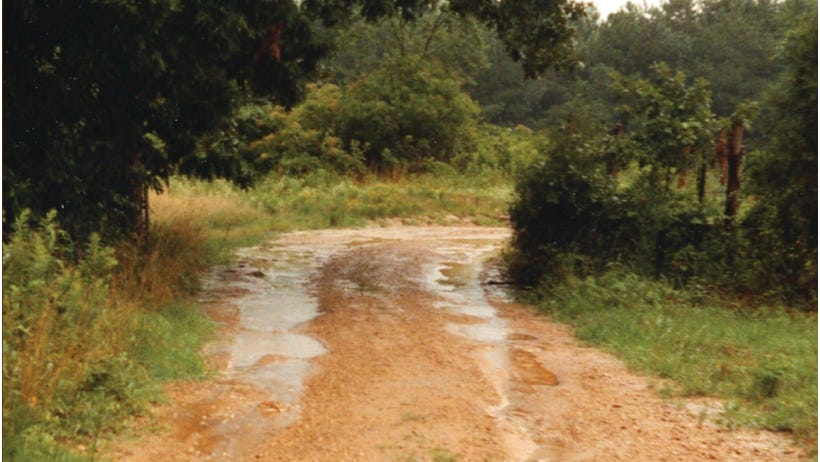
I have a memory of a book I read years ago that opens like this: It’s the early 1900s in rural Mississippi. A mother dies. Her grown sons must carry her body out of the house and into the cart to carry her to the cemetery (picture mud and rain and misery), but Mother is obese, so they take the front door off of its hinges and shift her body onto it to carry her out to the cart.
I was certain that the book was Faulkner’s As I Lay Dying, which I read about 45 years ago—and loved. I wanted to enjoy this book all over again, only a little edgy: what if I don’t love it as much now as I did then? But I jumped in. And yes, a mother dies, and yes, it’s raining and muddy and miserable. So far so good. But wait! This mother is a skinny little thing and no door comes off of its hinges, but the grown sons do put her in the back of a wagon to take her to be buried. Wait a gosh-darned minute! Where is the obese mother lying dead on her unhinged front door? Not in this book.
So what book did I read that had that wonderful opening? How could I carry this book-memory for so long and be so wrong?
Have you ever had this happen?
Something similar happened to me once, but it as a bookstore that disappeared.
Story: I moved to Colorado after many years in the San Francisco Bay Area, and on one visit back home, I went to the Pruneyard Shopping Center, an outdoor mall in Campbell that is “an iconic shopping and dining destination and experience designed to make the everyday extraordinary,” according to their website. I wanted to buy books at the Upstart Crow, a funky bookstore where a coffee grinder made lots of noise over the music and the chatter, and I would sit with a study group from SJSU and drink fresh ground coffee (a new thing back in the early ’80s—bookstore+coffee shop) while we talked about the poets we were studying. I wanted that smell, those sounds, that vibe. I wanted that bitter coffee and the sight of books by Alan Watts and Adrienne Rich and Audre Lorde.
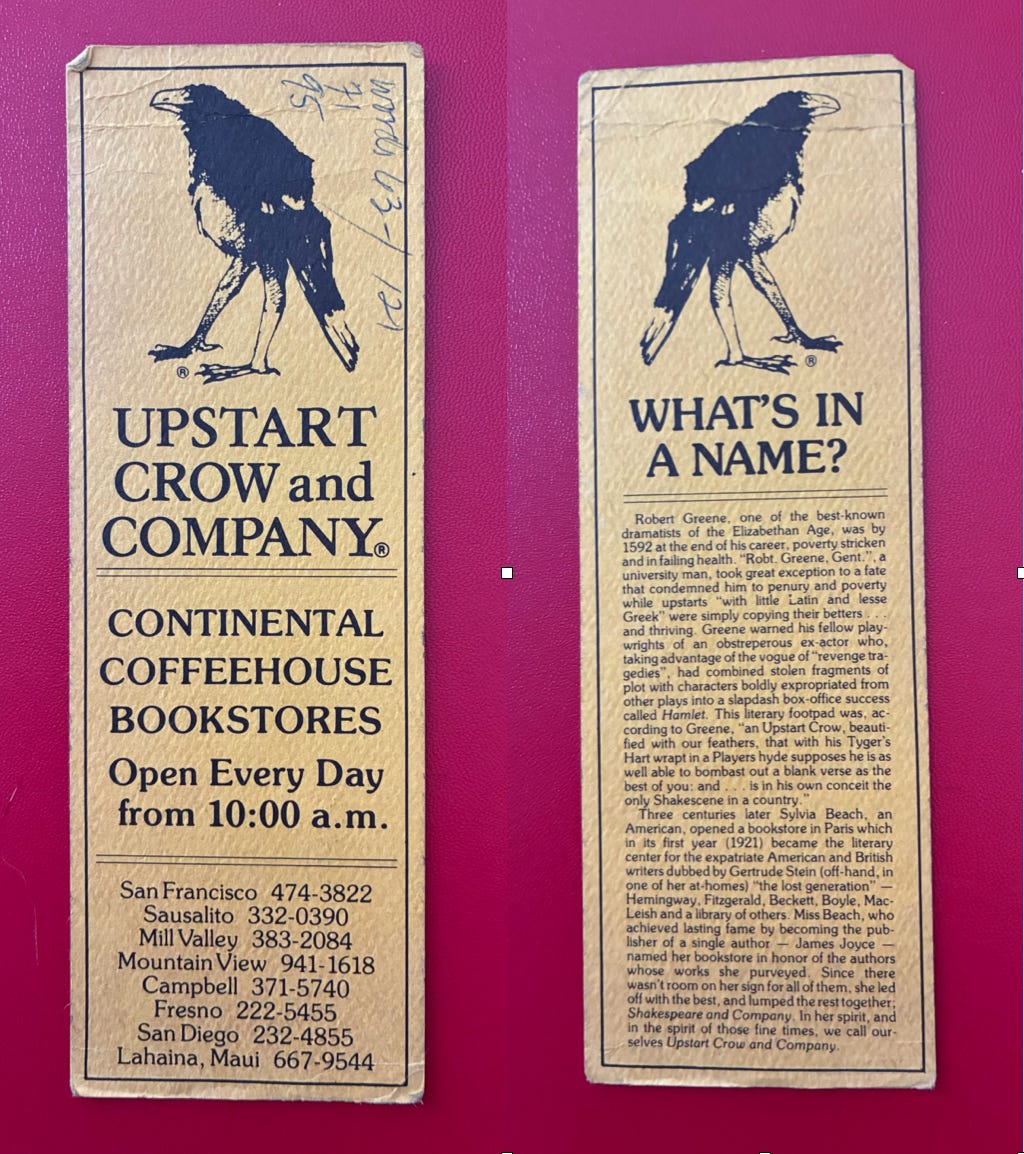
I knew exactly where the bookstore was, but when I got there, the Upstart Crow was gone. It had been replaced by a Little Professor Books, all clean and white and tidy and without a scent or any hint of feminist books by radical lesbians. I refused to believe it. So I walked around to the other side of mall to see I had misplaced “my” bookstore in my memory. Of course, I had not.
Things change. And apparently, so do memories.
That’s what throws me about the book memory: How could I be so wrong? What other books opens like that if it’s not Faulkner? I did check other Faulkner books, but no body was being carried out in the rain on an unhinged door. Did I make it up? If so, how very Faulknerian of me.
I’m rereading As I Lay Dying in spite of my memory glitch, and as I expected, I’m right there in the rain and the mud with the family of the dead (but skinny) mother. But with each new chapter, I’m secretly hoping that an obese mother dies and her sons carry her body out of the house on a door.
I’d love to hear your book-memory stories, and please—if you know of a book that opens with the scene from my memory, please let me know. It’s driving me crazy!
Note: The image at the top of the page is from my copy of As I Lay Dying
My white whale is a dimly-remembered tale about the residents in a low-rent hotel, one of whom fancied himself a poet. He wrote a poem about dying in which he shocked all his neighbors by proclaiming himself eager to be present for the event. The poem included the line, "I've loved my life, why should I miss its end?" (or something very like that). I've never been able to find that book again.
When I pasted your first paragraph into Claude, he came back with As I Lay Dying. So I corrected him, whereupon he came up with this:
The scene you're describing — an obese mother, door taken off its hinges, mud and rain, rural Mississippi, early 1900s — sounds like it could be from a different Southern novel entirely. A few possibilities that come to mind:
Erskine Caldwell wrote this kind of grim, grotesque rural Southern domestic scene (Tobacco Road, God's Little Acre)
Flannery O'Connor or Carson McCullers both worked in Southern Gothic with physically outsized characters
It's also possible it's a less canonical novel from the mid-20th century Southern tradition